
Lighting Guides
Buy LED Lights in India: A Practical Guide for Homes, Offices and Businesses
Planning to buy LED lights in India? Learn how to choose LED lights for homes, offices, shops, factories and outdoor spaces with this practical guide.
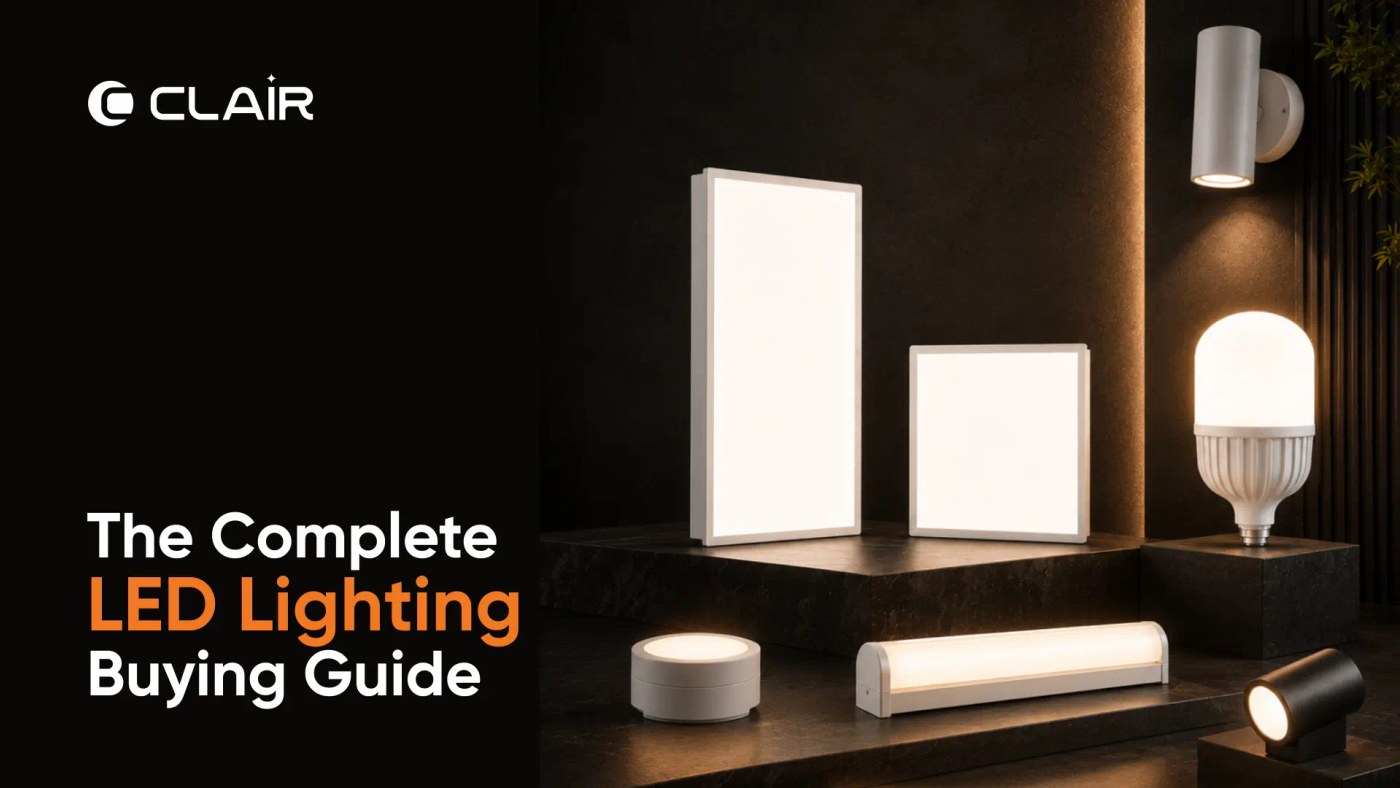
If you are planning to buy LED lights in India, the choice can feel simple at first. You look at the wattage, compare the price and pick the product that seems bright enough.
But good LED lighting is not chosen that way.
The right LED light depends on where it will be used, how much brightness the space needs, what colour temperature feels suitable, whether the light is for indoor or outdoor use, and how long it is expected to perform.
At Clair, we often see buyers compare LED lights only by price or wattage. That can lead to wrong product selection, uneven lighting, higher maintenance and poor long-term value. This guide explains how to buy LED lights in a more practical way, whether you are choosing lighting for a home, office, shop, factory, warehouse or outdoor area.
Why Buying LED Lights Needs More Than a Price Check
LED lights are available across many price points in India. A buyer can find LED bulbs, LED battens, LED panel lights, downlights, street lights, flood lights and high bay lights from several brands and retailers.
But the cheapest LED light is not always the most economical one.
A poor-quality LED light may consume more power than expected, give uneven brightness, flicker, heat up, fail early or lose output over time. In homes, this affects comfort. In offices, it affects visibility and productivity. In retail stores, it affects how products look. In factories and warehouses, it can affect safety and operations.
When you buy LED lights, the goal should be to choose the right light for the right application.
Step 1: Know Where the LED Light Will Be Used
The first step before you buy LED lights is to identify the application. Every space has a different lighting requirement.
LED Lights for Home
Homes need lighting that supports comfort, mood and daily use. Bedrooms and living rooms often need warm, comfortable lighting. Kitchens, study areas and bathrooms need clearer, more functional lighting.
Common LED lights for home include LED bulbs, LED downlights, COB lights, strip lights, surface lights and decorative lighting.
LED Lights for Office
Office LED lighting should support focus, screen work and visual comfort. LED panel lights, battens, downlights and linear lights are common choices for offices, cabins, meeting rooms, corridors and reception areas.
For office spaces, uniform brightness and reduced glare are important.
LED Lights for Shops and Retail Spaces
Retail lighting must make products visible, attractive and natural. A fashion store, jewellery showroom, supermarket and electronics store will not need the same type of light.
Track lights, COB downlights, strip lights and high CRI LED lights are often used for retail spaces.
LED Lights for Factories and Warehouses
Factories, warehouses and logistics spaces need LED lighting that supports safety, visibility and long operating hours. High bay LED lights, industrial battens, flood lights and linear lights are commonly used in these environments.
Here, buyers should look at mounting height, brightness, IP rating, surge protection and durability.
LED Lights for Outdoor Areas
Outdoor areas need lights that can handle dust, rain, heat and voltage fluctuations. LED street lights, flood lights, garden lights, facade lights and parking lights should be selected with proper IP rating and protection.
Step 2: Do Not Buy LED Lights Only by Wattage
Many buyers still ask for LED lights by wattage: 9W bulb, 20W tube light, 36W panel light or 100W flood light.
Wattage is important, but it only tells you how much power the light consumes. It does not fully tell you how much brightness the light gives.
For that, you need to look at lumens.
Lumens measure light output. A good LED light should give strong lumen output while using less electricity. This is why two LED lights with the same wattage may not perform the same way.
When you buy LED lights, compare both watts and lumens. This helps you understand whether the product is truly energy efficient.
Step 3: Choose the Right Colour Temperature
Colour temperature, also called CCT, is measured in Kelvin. It decides whether the light looks warm, neutral or cool.
Warm white lighting is usually around 2700K to 3000K. It feels soft, relaxed and comfortable. It works well for bedrooms, living rooms, restaurants, lounges and hospitality spaces.
Neutral white lighting is usually around 3500K to 4000K. It feels balanced and natural. It works well for offices, kitchens, schools, clinics and retail spaces.
Cool white or daylight lighting is usually around 5000K to 6500K. It feels brighter and sharper. It is often used in factories, warehouses, hospitals, parking areas and outdoor spaces.
Choosing the wrong colour temperature can make a space feel uncomfortable. A bedroom may feel too harsh with very cool light. A factory floor may feel dull with very warm light.
At Clair, we look at colour temperature as an application decision, not just a visual preference.
Section breaker CTA: Read Clair product specifications to choose LED lights by wattage, lumens, Kelvin, CRI, IP rating and application.
Step 4: Check CRI if Colour Accuracy Matters
CRI stands for Colour Rendering Index. It indicates how accurately colours appear under a light source.
If you are buying LED lights for a bedroom, basic office or parking area, very high CRI may not always be the first priority. But if you are buying LED lights for a retail store, salon, jewellery showroom, design studio, clinic, hotel or premium home interior, CRI becomes important.
Higher CRI lighting helps colours look more natural. This matters when products, materials, skin tones, fabrics, food or finishes need to appear correctly.
For many interior and commercial spaces, CRI 80 and above is preferred. For more colour-sensitive spaces, higher CRI may be required.
Step 5: Check IP Rating for Outdoor and Wet Areas
If you are buying LED lights for outdoor areas, bathrooms, gardens, factories, parking spaces or industrial sites, check the IP rating.
IP rating shows how protected a light is against dust and water.
Indoor dry areas may not need high protection. But outdoor and industrial spaces need stronger protection because the light may face rain, dust, moisture, cleaning water or harsh site conditions.
For outdoor LED lighting, buyers should look for suitable IP-rated products instead of using basic indoor lights outside. This helps improve safety, durability and product life.
Step 6: Think About Beam Angle and Light Spread
Beam angle tells you how wide or narrow the light spread will be.
A narrow beam is useful when you want to highlight a product, wall, artwork, facade or display. A wider beam is useful when you want general lighting across a room, office, shop or corridor.
This matters especially for LED downlights, COB lights, track lights, flood lights and architectural lighting.
If the beam angle is wrong, the space may get dark patches, harsh spots or uneven lighting. This is why buying LED lights should include both product selection and placement planning.
Step 7: Match the LED Product Type to the Space
Different LED lights are designed for different applications.
LED bulbs are commonly used in homes, small shops and general spaces.LED battens and tube lights work well for cost-effective general lighting.LED panel lights are suitable for offices, schools and commercial ceilings.LED downlights and COB lights are used for interiors, corridors, retail and premium spaces.Track lights are useful for showrooms, galleries and product displays.LED strip lights are used for cove lighting, furniture, shelves and decorative accents.LED street lights and flood lights are used for roads, parking areas, gardens and outdoor security.High bay LED lights are used in factories, warehouses and industrial sheds.
When you buy LED lights, selecting the right product category is as important as selecting the right wattage.
Step 8: Compare LED Light Price with Long-Term Value
LED light price in India can vary based on wattage, body material, driver quality, lumen output, CRI, IP rating, warranty, brand and application.
A lower-priced LED light may be suitable for basic use, but commercial and industrial buyers should also consider operating cost, maintenance cost and replacement frequency.
For businesses, the real cost of lighting includes:
Electricity consumptionProduct lifeReplacement costMaintenance effortDowntimeWarranty supportPerformance consistency
This is why LED lighting should be seen as a long-term decision, especially for offices, shops, factories, warehouses and outdoor projects.
Step 9: Choose a Brand That Offers Clarity and Support
When you buy LED lights, clear specifications matter. Buyers should be able to understand the wattage, lumens, colour temperature, CRI, IP rating, beam angle, warranty and application suitability.
For dealers, retailers, electricians, architects, contractors and project buyers, this clarity makes product selection easier.
At Clair, our focus is on making LED lighting easier to choose, easier to specify and easier to trust across different applications. With in-house manufacturing, process-led quality control and a wide LED lighting product range, we support lighting decisions for homes, offices, commercial spaces, industrial environments and outdoor applications.
Conclusion: Buy LED Lights for the Space, Not Just the Wattage
If you are planning to buy LED lights in India, do not choose only by price or wattage. Start with the space, then check brightness, colour temperature, CRI, IP rating, beam angle, product type, warranty and long-term value.
The right LED light can improve visibility, comfort, energy efficiency, safety and the overall experience of a space.
At Clair, we believe that every lighting decision should begin with a simple question: what does this space need the light to do?
Once that is clear, buying the right LED lights becomes much easier.
FAQs
1. What should I check before I buy LED lights?
Before you buy LED lights, check the application, wattage, lumens, colour temperature, CRI, IP rating, beam angle, warranty and product type. The right LED light depends on whether it is used in a home, office, shop, factory, warehouse or outdoor area.
2. Which LED lights are best for home use?
For homes, LED bulbs, downlights, COB lights, strip lights and surface lights are commonly used. Warm white lights work well for bedrooms and living rooms, while neutral white lights are useful for kitchens and study areas.
3. Which LED lights are best for offices?
LED panel lights, battens, downlights and linear lights are commonly used in offices. Office LED lighting should provide uniform brightness, visual comfort and efficient energy use.
4. Are expensive LED lights better than cheaper LED lights?
Not always, but price often reflects differences in driver quality, material, lumen output, heat management, warranty and product life. Instead of choosing only by price, compare specifications and long-term value.
5. Can LED lights help reduce electricity bills?
Yes, energy efficient LED lights can reduce electricity consumption compared with many older lighting systems. Savings depend on wattage, usage hours, number of lights, product quality and electricity tariff.